
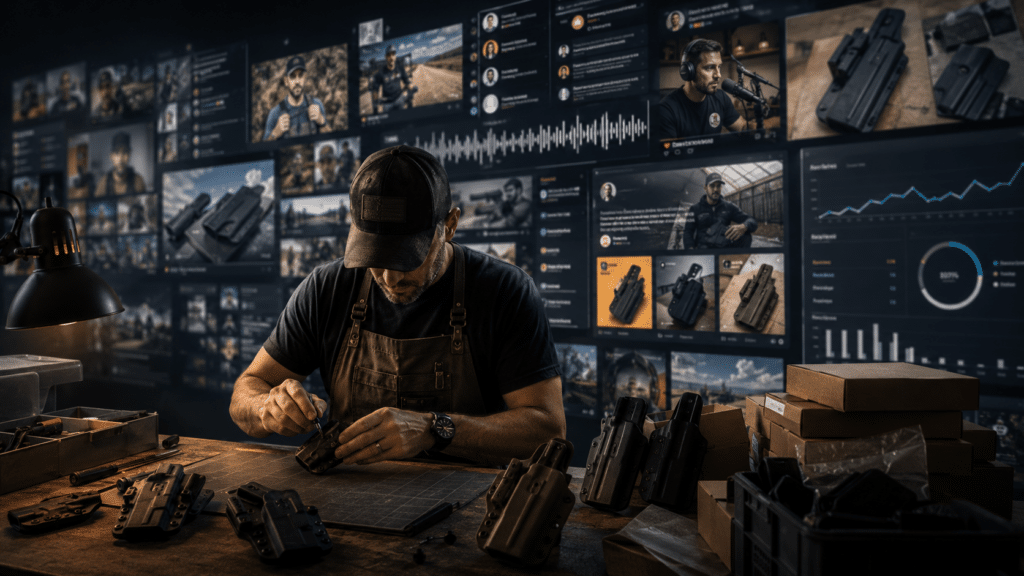
A lot of smaller and mid-market holster brands make strong products. Some of them make excellent products. They have good craftsmanship, solid customer service, smart designs, and loyal customers.
But in today’s market, product quality by itself is not enough.
The holster business has become a trust-and-attention game. And the companies winning that game are not just manufacturers. They are media companies, content machines, community builders, and direct-response marketers wrapped around a product.
That is why brands like Tier 1 Concealed, PHLster, Tenicor, T.REX Arms, Alien Gear, Vedder, We The People Holsters, Safariland, Galco, CrossBreed, LAS Concealment, Werkz, JM Custom Kydex, and others have become so visible in different parts of the market.
They do not all win the same way. But they all understand some version of the same principle:
The best product does not always win. The most trusted product in the buyer’s mind usually does.
The Real Competition Is Not Just Other Holsters
When a customer buys a holster, they are not simply buying a molded piece of Kydex, leather, or nylon.
They are buying confidence.
They are asking:
Will this be comfortable? Will it conceal? Will it retain the gun safely? Will it work with my body type? Will it work with my lifestyle? Will it work when I am seated, driving, walking, bending over, or carrying all day?
That is a lot of trust to ask from a buyer, especially a newer concealed carrier.
And when people are unsure, they tend to default to familiarity. They buy what they have heard of. They buy what their instructor mentioned. They buy what keeps showing up in YouTube videos, Reddit threads, EDC posts, podcasts, and gear guides.
That is where bigger marketing-driven brands have a massive advantage.
Big Brands Own Repetition
Modern holster marketing is built on repetition.
A potential customer sees a brand on Instagram. Then they hear it mentioned on a podcast. Then they see a YouTube review. Then it shows up in a Reddit recommendation. Then a trainer mentions it in a class. Then a friend says, “Yeah, that’s what I use.”
By the time that customer is ready to buy, the decision feels obvious.
That is not luck. That is a flywheel.
Some brands built that flywheel through influencer relationships and high-volume social content. Some built it through direct-response ads, SEO, and ecommerce funnels. Some built it through instructor credibility and enthusiast communities. Some built it through legacy brand recognition and distribution.
But the pattern is the same.
Visibility creates familiarity. Familiarity lowers risk. Lower risk increases sales.
Smaller Brands Usually Rely Too Much on Product Quality
This is where a lot of smaller holster companies get stuck.
They believe, “If people would just try our product, they would understand.”
They may be right.
But that is not a marketing strategy.
Customers do not try products they have never heard of. They do not recommend brands they cannot remember. They do not trust companies that have not shown up repeatedly in the places where they learn, ask questions, and make buying decisions.
In the firearms industry, trust compounds slowly. Then it looks sudden.
The company that appears to “come out of nowhere” usually did not come out of nowhere. They were stacking trust signals for years.
The Social Media Trap
A lot of smaller brands look at bigger companies and think the answer is simply more social media.
Post more reels. Get more followers. Do more product photos. Run more discount codes.
That may help, but it is not the whole answer.
The problem is that social media rewards frequency, personality, controversy, speed, and entertainment. A founder trying to run production, fulfillment, customer service, product development, dealer relationships, and marketing is already stretched thin.
Meanwhile, larger brands may have internal content teams, creator networks, ad budgets, affiliates, email systems, SEO strategies, and customer-generated content pipelines.
That is not a fair fight if the only battlefield is Instagram.
Smaller brands need a different strategy.
The Opportunity: Win Where Big Brands Are Less Personal
The good news is that smaller holster companies still have real advantages.
They can be more personal. They can move faster. They can serve narrower markets better. They can build deeper relationships with instructors, ranges, gun shops, trainers, and local communities.
That matters because holsters are not bought in a vacuum.
They are often chosen during moments of transition:
A new gun owner gets their first handgun. A CCW holder gets approved. A woman starts carrying daily. A church security volunteer needs better gear. A student takes their first defensive pistol class. Someone realizes their cheap Amazon holster is not going to cut it.
Those moments are powerful.
And in those moments, trusted guidance matters more than raw follower count.
California Is a Market Most National Brands Underserve
California is a perfect example.
California gun owners live in a very specific environment. They deal with legal complexity, social pressure, restrictive workplaces, urban carry realities, limited retail access, and a lot of first-time questions.
National holster brands may sell into California, but many do not speak directly to the California gun owner.
That creates an opening.
A smaller carry brand does not have to become the biggest holster company in America to win. It can become a trusted brand inside a specific community, with a specific message, solving specific problems for specific people.
That is how smaller brands punch above their weight.
The Next Generation of Holster Marketing
The next generation of successful holster brands will not win by copying everyone else’s Instagram strategy.
They will win by building trust pathways.
That means showing up in the places where serious gun owners are already learning and making decisions: training classes, instructor recommendations, community events, podcasts, YouTube searches, newsletters, gear guides, local advocacy groups, and real conversations with real carriers.
It means creating useful content, not just promotional content.
It means answering the questions buyers are already asking:
What holster should I buy first? What works for appendix carry? What works for women? What works for bigger body types? What works in hot weather? What works when I am driving? What setup do instructors actually trust?
That kind of content builds authority.
And authority is what smaller brands need if they want to compete against bigger marketing machines.
The Bottom Line
Smaller holster companies do not need to beat Tier 1, PHLster, Alien Gear, Tenicor, T.REX Arms, or the other major players at their own game.
They need to play a sharper game.
They need to become known, trusted, and recommended inside the communities where buying decisions actually happen.
That is the real opportunity.
Because in this industry, the strongest brands are not always the loudest.
They are the ones people trust when it is time to carry.